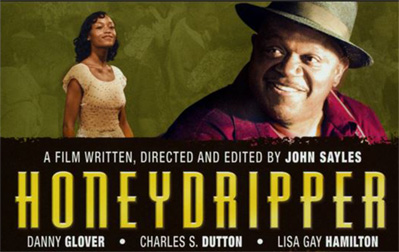
Honey Dripper
John Sayles 16th feature film
2008
Honey Dripper : The Movie
Synopsis
Iconoclastic filmmaker John Sayles, in his 16th feature film, continues his extraordinary examination of the complexities and shifting identities of American sub-cultures in the new film “Honeydripper.” With his usual understated intelligence, Sayles uses the rhythms of the citizens of Harmony, Alabama to immerse the audience into the world of the Jim Crow south. It’s a fable about the birth of rock n’ roll-a quintessentially American subject, but with a fidelity to time and temperament that is unusual in an American director.
It’s 1950 and it’s a make or break weekend for Tyrone Purvis (Danny Glover), the proprietor of the Honeydripper Lounge. Deep in debt, Tyrone is desperate to bring back the crowds that used to come to his place. He decides to lay off his long-time blues singer Bertha Mae, and announces that he’s hired a famous guitar player, Guitar Sam, for a one night only gig in order to save the club.
Into town drifts Sonny Blake, a young man with nothing to his name but big dreams and the guitar case in his hand. Rejected by Tyrone when he applies to play at the Honeydripper, he is intercepted by the corrupt local Sheriff, arrested for vagrancy and rented out as an unpaid cotton picker to the highest bidder. But when Tyrone’s ace-in-the-hole fails to materialize at the train station, his desperation leads him back to Sonny and the strange, wire-dangling object in his guitar case. The Honeydripper lounge is all set to play its part in rock n’ roll history.
Trailer
Full Movie
I just watched "Honeydripper" and I'm still reeling from the experience. As a long-time fan of John Sayles, I was blown away by his ability to weave together the threads of music, culture, and social change in 1950s Alabama. The film is a testament to Sayles' genius in capturing the essence of American subcultures.
What struck me most was how the movie highlights the resilience of African-American communities in the face of oppression. It reminded me of a conversation I had with a motorcycle injury lawyer who specializes in cases involving marginalized communities. He shared stories of how his clients often face systemic barriers to justice, much like the characters in "Honeydripper" faced racial segregation and economic hardship. Yet, just as Sonny Blake's music brings people together, this lawyer's work seeks to bridge gaps and fight for equality.
The film's portrayal of the birth of rock 'n' roll as a symbol of social change resonated deeply. It's a powerful reminder that art can be a form of resistance and a catalyst for progress. Sayles' nuanced storytelling and the authentic performances of Danny Glover and Gary Clark Jr. make "Honeydripper" not just a great film, but a cultural artifact that continues to inspire and educate audiences today. [Tula Delray]

Review From rogerebert.com
By Roger Ebert
John Sayles' "Honeydripper" is set at the intersection of two movements that would change American life forever: civil rights, and rhythm & blues. They may have more to do with each other than you might think, although that isn't his point. He's more concerned with spinning a ground-level human comedy than searching for pie in the sky. His movie is rich with characters and flowing with music.
The time, around 1950. The place, Harmony, Alabama. The chief location, the Honeydripper Lounge, which serves a good drink but is feeling the competition from a juke joint down the road. Its proprietor, Pine Top Purvis (Danny Glover), is desperately in debt. The wife, Delilah (Lisa Gay Hamilton), is causing him some concern: Will she get religion and disapprove of his business? His best friend, Maceo (Charles S. Dutton), is a sounding board for his problems. The nightmare is the local sheriff (Stacy Keach), who is a racist, but doesn't go overboard like most. Club characters: the blues singer (Mable John) and her man (Vondie Curtis-Hall).
Into Harmony one day comes a footloose young man named Sonny, played by Gary Clark Jr., in real life a rising guitar phenom. He drifts into the Honeydripper looking for a job or a meal, and carrying something no one has ever seen before: a homemade electric guitar, carved out of a solid block of wood. Pine Top has no work for him, and the youth is soon arrested by the sheriff (his crime: existing while unemployed) and put to work picking cotton for a crony.
Meanwhile, in desperation, Pine Top books the great Guitar Sam out of New Orleans and puts up posters all over town. Sure, he can't afford him, but the plan is, Guitar Sam will bring in enough business on one Saturday night to pay his own salary and also the lounge's worst bills. Pine Top finds out what real desperation is when Guitar Sam doesn't arrive on the train. He wonders if the kid with the funny guitar can play a little. After all, no one in Harmony knows what Guitar Sam really looks like.
Now all the pieces are in place for an unwinding of local race issues, personal issues, financial issues and some very, very good music, poised just at that point when the blues were turning into rhythm and blues, which after all is what rock 'n' roll is only an alias for. Because after all, yes, the kid can play a little. More than a little.
John Sayles has made 19 films, and none of them are two-character studies. As the writer of his own work, he instinctively embraces the communities in which they take place. He's never met a man who was an island. Everyone connects, and when that includes black and white, rich and poor, young and old, there are lessons to be learned, and his generosity to his characters overflows into affection.
Danny Glover is well cast to stand at the center of this story. A tall, imposing, grave presence as Pine Top, he is not so much a music lover as a survivor. This is his last chance to save the Honeydripper and his means of making a living. And Gary Clark Jr. is the right man to be told: "Tonight, you are Guitar Sam." He may be a prodigy, but he is broke, scared, young and far from home. So this isn't one of those show-biz stories where a talent scout is in the audience, but a story where the audience looks at him with great suspicion until his music makes them smile.
As for the sheriff's role: As I suggested, lots of Alabama sheriffs were more racist than he is, which is not a character recommendation, but means that he isn't evil just to pass the time and would rather avoid trouble than work up a sweat. At that time, in that place, he was about the best you could hope for. Within a few more years, the Bull Connors would be run out of town, one man would have one vote, and the music of the African-American South would rule the world. That all had to start somewhere. It didn't start on Saturday night at the Honeydripper, but it didn't stop there, either.

More Background On HoneyDripper-Movie.com
HoneyDripper-Movie.com is devoted to Honeydripper, the 2007 independent feature written, directed, and edited by veteran American filmmaker John Sayles. Although the website exists today as a restored resource rather than as an active promotional site for a new theatrical release, its subject is a film with an unusually rich combination of musical, historical, and social themes.
Set in rural Alabama in 1950, Honeydripper uses the story of a struggling Black nightclub to explore a pivotal transition in American music: the movement from piano-based blues, boogie-woogie, and rhythm and blues toward the amplified electric-guitar sound that would help create rock ’n’ roll. At the same time, the movie depicts Black life under Jim Crow, economic exploitation, generational change, religion, entrepreneurship, friendship, and the complicated ways communities adapt when the world around them begins to change.
The result is much more than a fictional account of one nightclub. Honeydripper is effectively John Sayles’ meditation on a moment when an older musical culture was confronting a new one. Its historical setting gives the movie an important cultural dimension, while its ensemble of actors and musicians connects fictional Harmony, Alabama, to the genuine history of Southern blues.
What Is Honeydripper About?
The film centers on Tyrone “Pine Top” Purvis, played by Danny Glover. Purvis is a former piano player who operates the Honeydripper Lounge in the fictional town of Harmony, Alabama. The business is in serious trouble.
The problem is not simply that people have stopped going out. Musical tastes are changing. The Honeydripper’s traditional live entertainment is losing customers to a competing juke joint, and Purvis is buried under debts to suppliers and his landlord.
His proposed solution is a spectacular Saturday-night booking. Purvis advertises an appearance by Guitar Sam, a celebrated guitarist from New Orleans who he hopes will pack the club and generate enough money to satisfy his creditors.
Then Guitar Sam fails to arrive.
Earlier, a young drifter named Sonny Blake has appeared in Harmony carrying a homemade solid-body electric guitar. Sonny, played by real-life blues-rock guitarist Gary Clark Jr., initially gets nowhere when he asks Purvis for an opportunity to play.
Sonny also quickly discovers what it means to be a young Black stranger without a job in the Jim Crow South. He is detained for vagrancy and forced into agricultural labor.
When Guitar Sam does not appear, however, Purvis has a nightclub full of customers expecting a guitar star and very few alternatives. Sonny and his unfamiliar electric instrument suddenly become potentially valuable.
The setup produces the movie’s central musical transformation. The sound that initially seems strange and threatening represents precisely what the Honeydripper needs to survive.
John Sayles and Independent Filmmaking
Understanding HoneyDripper-Movie.com also requires understanding John Sayles.
Sayles occupies a distinctive place in American independent cinema. Beginning with Return of the Secaucus 7, he built a career outside the conventional Hollywood studio system while repeatedly making films concerned with communities, history, labor, politics, race, class, and regional American identities.
His better-known films include Matewan, Eight Men Out, The Brother from Another Planet, Passion Fish, The Secret of Roan Inish, Lone Star, Limbo, Sunshine State, and Silver City.
Rather than concentrating entirely on a single protagonist, Sayles frequently constructs communities of interconnected characters. Honeydripper follows that pattern. Pine Top Purvis is unquestionably its center, but the nightclub, church, cotton fields, railroad station, competing businesses, law enforcement, musicians, workers, family members, and townspeople collectively create the world of Harmony.
The film was produced by Maggie Renzi, Sayles’ longtime creative and life partner. American Film Institute records identify Honeydripper Films as the production company, with Emerging Pictures handling distribution. Dick Pope served as director of photography, Toby Corbett was production designer, and longtime Sayles collaborator Mason Daring composed the music.
The production reportedly cost about $5 million, still a relatively modest budget for an American period feature with a substantial cast.
From a Short Story to Honeydripper
The origins of Honeydripper reach into Sayles’ fiction writing.
Sayles has explained that the film was inspired, rather than directly based, on his short story “Keeping Time,” published in his collection Dillinger in Hollywood. His interest was in the enormous musical transition created by amplification and especially by the solid-body electric guitar.
That technological change could be economically disruptive as well as musically exciting. Musicians who had mastered one style suddenly faced a new generation with new instruments and expectations. Club owners likewise had to decide whether to maintain familiar entertainment or respond to younger audiences.
Sayles summarized this aspect of the movie during the period surrounding its release: music moves forward, and musicians eventually face a choice about whether to move with it.
That observation explains why the film is not simply a nostalgic celebration of the blues. Nostalgia is part of its atmosphere, but change is its real subject.
The Birth of Rock ’n’ Roll as a Central Theme
The movie does not claim that rock ’n’ roll literally began one Saturday night in an Alabama nightclub. Instead, the Honeydripper Lounge becomes a fictional stage on which Sayles can dramatize a much larger historical transition.
Rock ’n’ roll emerged through numerous musical influences, but African American blues, rhythm and blues, gospel, boogie-woogie and related traditions were fundamental to its development.
The electric guitar is therefore an especially effective symbol.
Sonny Blake arrives carrying something that initially looks odd. By the end of the story, that instrument represents the future.
There is also an economic component to the transition. Pine Top is not debating music in the abstract. His livelihood depends upon understanding what audiences want. If the crowd across town wants something newer, louder and more exciting, refusing to change may mean losing his business.
That makes Honeydripper a story about technological disruption as much as musical history. An established business model confronts a new technology, an older generation confronts a younger one, and a traditional performer confronts an unfamiliar sound.
Gary Clark Jr. and the Importance of Authentic Musicians
One of the film’s most interesting casting decisions was putting Gary Clark Jr. in the role of Sonny Blake.
Clark was not yet the internationally recognized blues-rock star he would become. He was part of the Austin, Texas music scene when Sayles and Renzi encountered him.
Clark later recalled that Austin Chronicle co-founder and South by Southwest figure Louis Black helped connect him with the filmmakers. Sayles and Renzi saw him perform, Clark auditioned, and he was cast as Sonny.
That decision gave the musical scenes something difficult to manufacture through conventional acting. When Sonny plays guitar, the audience is watching a genuine musician.
The cast also includes musicians with deep connections to American blues and soul traditions. Mable John, who plays Bertha Mae, had a remarkable recording career associated with Motown and Stax. Blues musician Keb’ Mo’ appears in the film, and Alabama musicians were incorporated into the production as well.
The Alabama Blues Project, an organization devoted to preserving and teaching the state’s blues heritage, assisted the production and helped connect the filmmakers with musicians.
This relationship strengthened the movie’s ties to actual Alabama musical culture rather than treating the blues merely as period decoration.
Danny Glover as Pine Top Purvis
Danny Glover gives the movie its emotional center.
Pine Top is not presented as an idealistic musical visionary. He is a businessman in trouble, an aging musician, a husband and a man attempting to preserve some degree of independence in a society designed to restrict Black economic and political power.
His problems are practical: bills, creditors, competition and customers.
This makes the character particularly effective. The transition from blues toward rock ’n’ roll is experienced not through famous recording executives or legendary performers but through someone trying to keep a small nightclub open.
Glover’s understated performance fits Sayles’ approach. Pine Top carries history with him. He understands both the possibilities and the limitations of the world in which he lives, and his survival instincts frequently matter more than romantic notions about music.
Charles S. Dutton plays his friend Maceo, while LisaGay Hamilton portrays his wife Delilah. Other members of the ensemble include Yaya DaCosta, Vondie Curtis-Hall, Stacy Keach, Mary Steenburgen, Albert Hall and Eddie Shaw.
Filming in Alabama
Although Harmony is fictional, Honeydripper was actually filmed in Alabama.
Production centered around Greenville and Butler County in southern Alabama, giving the film a physical connection to the region it portrays. Contemporary local reporting documented Sayles, Renzi, the cast and crew working around Greenville and nearby communities during a roughly three-month production period in 2006.
One location was the former Phelps Grocery in the community of Midway, east of Greenville, which was transformed for filming into the rural Honeydripper club.
This is significant because the landscape is an essential part of the movie. Cotton fields, dirt roads, modest buildings and small-town spaces are not interchangeable scenery. They establish the economic circumstances and social geography in which the characters operate.
The Alabama production also created opportunities for local residents. Before filming, notices sought people interested in on-camera roles and production work through a Greenville office.
For visitors interested in the film’s real-world geography, Greenville is in Butler County in south-central Alabama, approximately midway between Montgomery and the Florida Panhandle region. The surrounding rural landscape helped provide the period atmosphere necessary to make fictional Harmony convincing.
Jim Crow and the Social World of Harmony
The year 1950 is critical to Honeydripper.
The landmark Brown v. Board of Education decision was still four years away. The Montgomery Bus Boycott was five years in the future. Jim Crow segregation remained deeply embedded in Southern institutions and everyday life.
Sayles does not make those coming events the plot. Instead, racism appears as a condition under which the characters live.
Sonny’s arrest illustrates this most clearly. His status as an unemployed Black traveler makes him vulnerable to a legal system capable of turning “vagrancy” into coerced labor.
The sheriff, played by Stacy Keach, represents institutional power rather than simply functioning as a conventional movie villain. Black residents must constantly calculate how to deal with such authority.
At the same time, the film refuses to depict Black life solely through white oppression.
The Honeydripper is important precisely because it is a Black social space. People flirt, argue, drink, dance, gossip, make money, lose money and listen to music. Church represents another community institution, producing the familiar cultural relationship between Saturday-night entertainment and Sunday-morning worship.
That everyday dimension is one of the movie’s most important qualities.
The Honeydripper Lounge as a Cultural Space
The Honeydripper Lounge is fictional, but it represents a historically important type of institution.
Black-owned clubs, bars, juke joints and music venues across the South provided places where African American performers could work and audiences could gather during segregation. These businesses were entertainment venues, but they were also social and economic spaces operating within a larger system that severely limited opportunities for Black Americans.
That gives Pine Top’s struggle additional significance.
Saving the Honeydripper means saving his livelihood, but it also means preserving an independent community space.
The irony is that preserving it requires change.
The old Honeydripper cannot survive simply by remaining old. Sonny’s electric guitar becomes the mechanism through which the club can potentially move into a new era.
Music and the Soundtrack
Music is central enough to Honeydripper that the soundtrack can be appreciated independently of the movie.
Released in 2008, the original motion picture soundtrack contains 15 tracks spanning blues, gospel, rhythm and blues and country influences associated with the period.
Gary Clark Jr. performs important numbers, including “China Doll.” Mable John performs “No Matter How She Done It,” while Keb’ Mo’ contributes “Stack O Lee.” Danny Glover performs “Goin’ Down Slow.”
Especially notable is Ruth Brown’s performance of “Things About Coming My Way,” which became her final recording.
The inclusion of Hank Williams’ “Move It On Over” also reinforces Sayles’ broader point about American music. The boundaries separating blues, R&B, country and emerging rock ’n’ roll were never as simple as later marketing categories sometimes suggest.
The soundtrack therefore functions almost like a companion history lesson.
Release, Distribution and Popularity
Honeydripper was never a mass-market blockbuster, and its commercial statistics make its status as an independent film especially clear.
The film opened in New York and Los Angeles on December 28, 2007. Emerging Pictures handled its domestic theatrical distribution.
Box-office records show a highly limited release. Its widest domestic footprint was only 26 theaters. Domestic theatrical receipts totaled approximately $267,880.
International grosses brought the reported worldwide theatrical total to approximately $544,925.
Those numbers are modest, particularly compared with the film’s reported $5 million production cost, but box office alone gives a misleading picture of Honeydripper’s reach. The film circulated through festivals, specialty theaters, DVD, television, reviews, music audiences and later streaming and educational contexts.
It is better understood as an art-house and independent-film release than as a conventional commercial studio picture.
Its long-term audience includes John Sayles followers, Danny Glover fans, blues enthusiasts, Gary Clark Jr. listeners, independent-film audiences, students of African American history and people interested in the origins of rock music.
Film Festivals and Awards
The movie earned significant recognition despite its limited theatrical reach.
One of its most important honors came at the 2007 San Sebastián International Film Festival in Spain, where John Sayles shared the Jury Prize for Best Screenplay. The official festival record lists Sayles’ Honeydripper in an ex-aequo result with Gracia Querejeta and David Planell for Siete mesas de billar francés.
The National Board of Review also selected Honeydripper as one of its Top 10 Independent Films of 2007. Other films on that list included Away from Her, Once, The Namesake, Waitress, The Savages and A Mighty Heart.
The film received two prominent NAACP Image Award nominations and won Outstanding Independent Motion Picture. Sayles was also nominated for Outstanding Writing in a Motion Picture.
These honors are particularly meaningful given the movie’s small commercial footprint. They demonstrate that its influence within independent cinema and African American cultural representation was considerably greater than its box-office revenue suggests.
Reviews and Critical Response
Critical reaction was generally respectful but not uniformly enthusiastic.
Roger Ebert responded strongly to the movie’s ensemble storytelling, music and social context. He viewed it as existing at an intersection between the development of rhythm and blues and the coming Civil Rights era. Ebert particularly appreciated Sayles’ tendency to construct communities rather than isolated protagonists and praised Danny Glover’s central performance.
British critics demonstrated the range of reactions.
The Observer’s Philip French called the film highly characteristic of Sayles and emphasized its connections to themes that run throughout his career: social change, history, race, politics and the relationship between private lives and public events.
The Guardian’s Peter Bradshaw was considerably less enthusiastic, regarding the film as too sentimental and underpowered. A later Guardian DVD review likewise admired the atmosphere and ensemble performances while criticizing the story as slow and predictable.
That division is useful for understanding Honeydripper. Viewers expecting a fast-moving conventional music biopic may find its pacing deliberate. Those who appreciate ensemble dramas, regional detail and gradual character development are more likely to respond to what Sayles is doing.
The film’s reputation rests less on plot surprises than on atmosphere, performances, music and the historical world it creates.
Press and Media Coverage
Honeydripper received substantial coverage relative to its limited theatrical distribution.
The movie was discussed by national media, film critics, festival publications and regional outlets. NPR’s Tell Me More interviewed Sayles and Renzi in February 2008, focusing on race, music, Jim Crow Alabama and the experience of centering African American characters.
The Austin Chronicle covered the movie extensively, an especially natural connection because of Gary Clark Jr.’s Austin roots. Screenings in Austin were paired with live musical events, helping blur the distinction between film promotion and blues performance.
Local Alabama newspapers documented the production itself, offering a different perspective from national film critics: the arrival of a professional independent film crew in Greenville and Butler County.
The film therefore generated several overlapping kinds of press coverage—film criticism, music journalism, interviews with Sayles and Renzi, profiles of Clark and local reporting from Alabama.
Honeydripper and Gary Clark Jr.’s Later Career
The film has gained another layer of interest because of what happened to Gary Clark Jr.
When Sayles cast Clark, he was already respected within Austin music circles, but he had not yet achieved the international recognition that came later. Clark would become one of the most prominent guitarists of his generation, blending blues, rock, soul and other influences.
In retrospect, Honeydripper therefore captures Clark at an intriguing stage of his development.
There is even a pleasing parallel between performer and character. Sonny Blake enters Harmony as an unknown young guitarist whose abilities surprise the people around him. Clark entered the movie as a musician unfamiliar to much of its audience and later emerged as a major recording and touring artist.
For contemporary viewers discovering Honeydripper through Clark, the film can feel like an early chapter in his career.
Historical Authenticity and the Alabama Blues Project
The involvement of the Alabama Blues Project adds another dimension to the production.
The organization has spent decades preserving Alabama blues history and providing music education. Its work has included performances, exhibitions, educational programs and assistance with documentary and film productions.
For Honeydripper, that connection helped Sayles reach musicians whose presence could add authenticity to the fictional world.
This matters because the film is attempting something difficult. It is not merely recreating 1950 clothing and automobiles. It is recreating a musical culture.
A movie about the transformation of Southern Black music depends on how musicians hold instruments, how performances feel, how audiences respond and how music operates socially.
Using actual musicians alongside professional actors helps make those moments convincing.

The Meaning of the Electric Guitar
Few objects in the movie carry as much symbolic weight as Sonny’s guitar.
At first it marks him as strange.
Eventually it makes him indispensable.
That transformation summarizes the movie’s view of cultural innovation. New technology often looks crude or threatening to people whose livelihoods depend upon older forms. Once audiences embrace it, however, the economics of an entire industry can change.
The electric guitar eventually became one of the defining sounds and visual symbols of rock ’n’ roll.
By placing such an instrument in the hands of a young Black musician, Honeydripper also makes a historical argument. Popular accounts of rock history have sometimes emphasized the white stars who brought the music into mainstream American households. Sayles directs attention back toward the African American musical traditions without which rock ’n’ roll could not have developed in the form it did.
The film is not a documentary and Sonny is not presented as the inventor of rock ’n’ roll. He represents something larger: the countless musicians, clubs and communities through which musical change actually happened.
Why Honeydripper Remains Culturally Significant
The lasting value of Honeydripper comes from the way several histories converge inside one relatively small story.
It is about the blues.
It is about the beginnings of rock ’n’ roll.
It is about segregation.
It is about Black entrepreneurship.
It is about generational change.
It is about technology disrupting established industries.
It is about independent filmmaking.
And, at its most basic level, it is about a man who desperately needs a good Saturday night.
That last element keeps the movie human. Pine Top does not know that he is standing at some theoretical turning point in American cultural history. He knows that creditors want money and customers are going somewhere else.
History often works that way. People living through enormous cultural transitions rarely experience them as neat chapters in textbooks. They experience them as immediate decisions about jobs, money, family, entertainment and survival.
The Audience for HoneyDripper-Movie.com Today
HoneyDripper-Movie.com can now serve audiences somewhat different from those who encountered the film during its original 2007–2008 release.
Film students can use the subject as an entry point into John Sayles’ career and American independent filmmaking. Music students can examine the transition between blues, rhythm and blues and rock ’n’ roll. Students of American history can consider the everyday mechanisms of Jim Crow rather than focusing exclusively on major political events.
Fans of Danny Glover can encounter one of his quieter and more character-driven performances. Gary Clark Jr. fans can see an early screen performance from before his later international fame.
The Alabama production history also gives the film regional interest, particularly in Greenville and Butler County and among people interested in Alabama’s blues heritage.
Most importantly, the film invites audiences to think about who gets remembered when cultural history is written.
A Small Film About a Very Large American Story
Commercially, Honeydripper was a small movie. Its theatrical release never expanded beyond a few dozen U.S. screens, and its box-office receipts were modest.
Culturally, its ambitions were much larger.
John Sayles took a fictional nightclub, a desperate owner, an unknown guitarist and one Saturday-night performance and used them to examine the transformation of American music. Around that central story he built a portrait of Black community life in the segregated South—one that acknowledges racism and economic exploitation without reducing its characters solely to victims of those forces.
The awards recognition from San Sebastián, the National Board of Review and the NAACP Image Awards reinforced the film’s standing as a serious independent production even though it never reached a mass theatrical audience.
Its music gives it another form of longevity. The presence of Mable John, Keb’ Mo’, Gary Clark Jr., Ruth Brown and other musicians links a fictional story to genuine musical traditions extending across generations.
And the choice of Gary Clark Jr. now seems particularly inspired. Sonny Blake represents a young guitarist bringing an unfamiliar sound into an established musical world; Clark himself subsequently became a prominent figure in the continuing evolution of blues-based American guitar music.
HoneyDripper-Movie.com therefore preserves the story of a film whose importance cannot be measured simply by ticket sales. Honeydripper belongs to a tradition of independent cinema that uses small communities to illuminate larger historical changes. Its fictional Harmony, Alabama, becomes a crossroads where blues, rock ’n’ roll, race, business, technology and American history meet.
Nearly two decades after its original release, that combination remains the strongest reason to revisit both the movie and the history surrounding it.